
Introduction
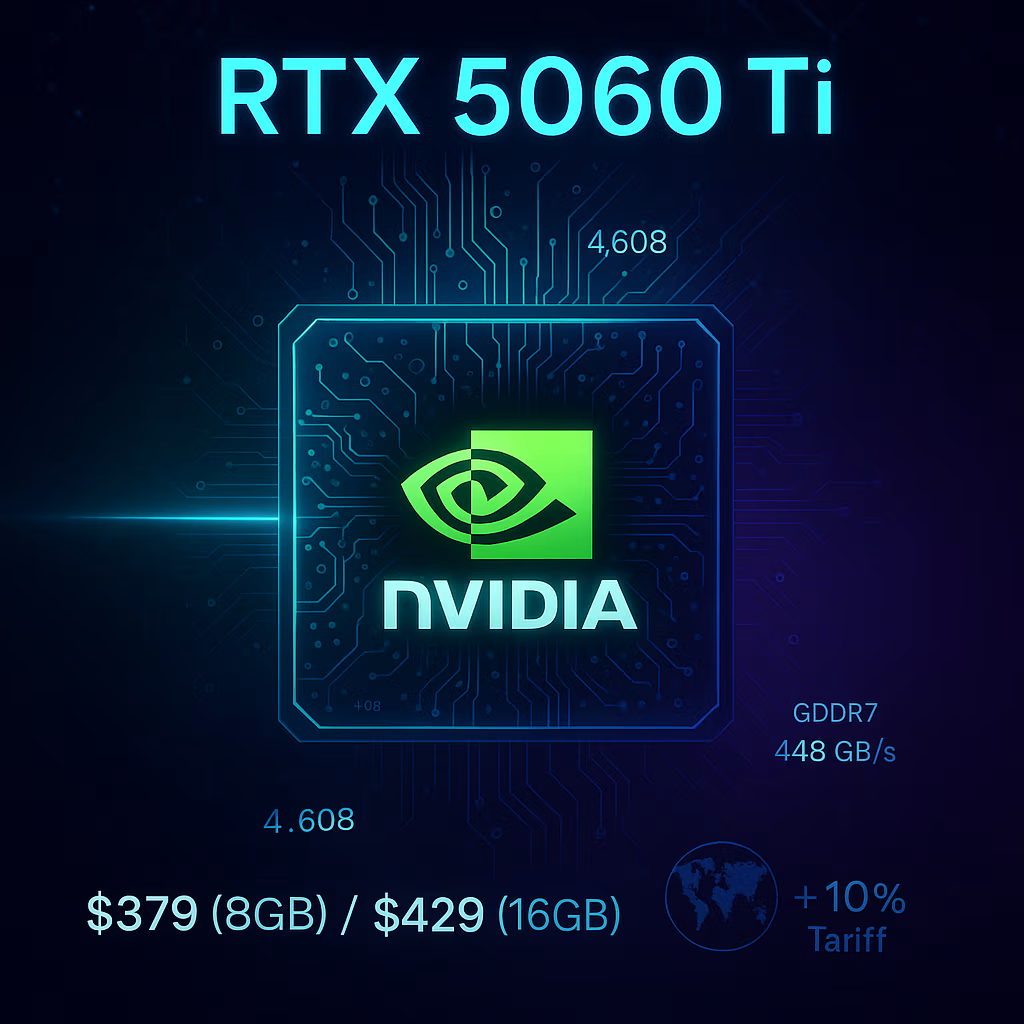
As the graphics card market continues to evolve rapidly, NVIDIA’s RTX 50-series has captured significant attention from gamers, PC builders, and tech enthusiasts alike. At the forefront of this new generation is the RTX 5060 Ti, which has been touted as NVIDIA’s answer to deliver mainstream performance coupled with advanced features such as DLSS 4 and the latest Blackwell architecture innovations. The RTX 5060 Ti is available in two variants – a base model with 8 GB of GDDR7 VRAM starting at an MSRP of approximately $379 and a higher-end 16 GB version priced around $429.
Summary
Yet, the excitement surrounding the new GPU is tempered by market uncertainties, including the lingering effects of new tariffs on imported components (especially those affecting Chinese manufacturing and semiconductor supplies) and fluctuating supply chain dynamics. This article will analyze the technical innovations, performance expectations, pricing strategy, and tariff challenges facing the RTX 5060 Ti, shedding light on its role in NVIDIA’s broader market strategy.
The RTX 5060 Ti in Context: A New Mainstream Offering
Evolution of NVIDIA’s Mid-Range GPUs
Historically, NVIDIA’s mid-range cards have struck a balance between cost and performance, targeting gamers who demand high-quality 1080p or entry-level 1440p gaming without the hefty price tag of high-end models. The RTX 3060 and RTX 4060 series, while widely popular, have faced criticism over their VRAM capacities and sometimes lagged behind in real-world performance. With the RTX 5060 Ti, NVIDIA aims to address these concerns by enhancing both the raw performance and the feature set using their new Blackwell architecture and fast GDDR7 memory.
Recent announcements suggest that this new generation is optimized for AI-powered improvements, particularly with the introduction of DLSS 4 Multi Frame Generation. This feature has the potential to significantly boost frame rates and deliver smoother gameplay by generating additional frames via neural rendering. In this sense, the RTX 5060 Ti is not merely a generational performance upgrade but also introduces next-level AI rendering technologies that extend its longevity in a competitive market.
Key Specifications Overview
According to various sources, including coverage from The Verge and Tom’s Hardware, the RTX 5060 Ti is powered by NVIDIA’s GB206 GPU. The key specifications are as follows:
- CUDA Cores: Approximately 4,608, achieved by utilizing 36 Streaming Multiprocessors (SMs).
- Memory Interface: A 128-bit memory bus paired with GDDR7 memory clocked at 28 Gbps, delivering a peak bandwidth of around 448 GB/s.
- Power Draw: The GPU is rated at about 180 W TGP, making it efficient enough for mainstream systems.
- VRAM Options: Two configurations will be available – an 8 GB variant and a 16 GB variant.
- Pricing: The expected MSRP starts at $379 for the 8 GB version and $429 for the 16 GB version.
These figures indicate not only a modest increase in core counts compared to previous generations but also an important architectural and memory speed upgrade, which NVIDIA claims will yield roughly a 20% performance increase over its immediate predecessor, the RTX 4060 Ti [theverge.com]
Technical Innovations Behind the RTX 5060 Ti
The Blackwell Architecture and GDDR7 Memory
At the heart of the RTX 5060 Ti is NVIDIA’s new Blackwell architecture. This architecture is significant for several reasons. First, it represents a refined chip design that maximizes power efficiency and performance—a crucial factor when targeting the highly competitive mid-range market. The Blackwell architecture also integrates robust AI and ray tracing engines, enabling advanced rendering techniques that elevate gaming visual fidelity.
A key part of Blackwell is the support for GDDR7 memory, which sets it apart from its predecessors that relied on GDDR6. With memory speeds of 28 Gbps, the RTX 5060 Ti’s memory subsystem can deliver up to 448 GB/s of bandwidth, which is about a 55% improvement over the RTX 4060 Ti. This increased bandwidth ensures that data is transferred quickly between the GPU and memory—a vital metric for handling higher-resolution textures and complex scenes in modern games [evrimagaci.org].
DLSS 4 and Multi Frame Generation
Another innovative leap in the RTX 5060 Ti is its integration of DLSS 4 (Deep Learning Super Sampling), which now incorporates Multi Frame Generation technology. DLSS 4 uses AI algorithms to synthesize extra frames, potentially boosting performance by up to eight times in supported titles. For example, benchmark data from NVIDIA highlights that in games like Cyberpunk 2077, enabling DLSS 4 can transform gameplay by increasing frame rates dramatically—from 61 FPS in native rendering to as high as 171 FPS with frame generation techniques enabled [polygon.com].
This technology is particularly important for mid-range GPUs like the RTX 5060 Ti because it allows for smoother gameplay even on resource-constrained systems. Lower latency, improved visual clarity, and heightened responsiveness collectively contribute to an enhanced gaming experience that can keep the RTX 5060 Ti competitive for years to come.
AI and Neural Rendering Enhancements
NVIDIA has long touted the potential of AI-powered features in its GPUs, and the RTX 5060 Ti is no exception. Neural rendering techniques, which are part of the DLSS 4 suite, leverage machine learning to improve image quality on the fly. This can not only refine the graphics but also decrease the load on the GPU by rendering at lower resolutions and then upscaling with minimal loss in detail. The integration of these techniques positions the RTX 5060 Ti as a future-proof choice, capable of utilizing advancements in AI to remain relevant even as gaming requirements continue to grow.
Pricing Strategy and Market Positioning
MSRP and Value Proposition
The pricing for the RTX 5060 Ti has been set with competitive balance in mind. The 8 GB model is expected to retail at around $379, while the 16 GB model comes in at about $429. This range places the RTX 5060 Ti squarely within reach for mainstream gamers—those upgrading from older models like the RTX 3060 or 4060 series, or even GTX cards from previous generations.
By contrast, high-end cards like the RTX 5070 and above command significantly higher prices (with the RTX 5070 starting around $549 and the RTX 5090 reaching nearly $2,000). With this tiered pricing, NVIDIA can capture a broader segment of the market. The RTX 5060 Ti is particularly attractive for 1080p gaming, where performance gains can be fully leveraged without the need for extremely high-end hardware.
Pre-Built Systems and Real-World Price Variability
Recent listings from pre-built system vendors reveal that the RTX 5060 and RTX 5060 Ti are already appearing in OEM systems. For example, pre-built PCs from CyberPowerPC and Stormcraft have been listed with these new GPUs at prices slightly varying from their MSRP. One model featuring the RTX 5060 (8 GB) was observed on Best Buy around $1,149 for a full system with a Ryzen 7 8700F CPU, 16 GB DDR5, and a 2 TB SSD. Similarly, several systems from Stormcraft featuring either the RTX 5060 or RTX 5060 Ti paired with 14th-gen Intel CPUs have been listed in the $1,299 to $1,499 range [tomshardware.com].
These listings reflect the reality that while MSRP provides a baseline, actual street prices may be higher due to supply constraints and market demand. In the past, even NVIDIA’s mid-range cards have seen a markup on third-party platforms, partly because of scalping and inventory shortages.
The Impact of Tariffs on GPU Pricing
Current Tariff Landscape and Market Uncertainty
The pricing dynamics of computer components, including GPUs, are never determined solely by supply and demand—they are also deeply influenced by international trade policies. One of the most notable factors today is the imposition of tariffs on imported goods, particularly those manufactured in China. In recent updates, tariffs—often associated with policies initiated by political figures like former President Trump—have continued to drive up the cost of hardware components.
For instance, certain Chinese imports now face a base tariff of 10% on top of other applicable fees. Although tariffs on GPUs have been a moving target—with some products temporarily spared from additional surcharges—the overall trend of rising costs due to these tariffs has created significant uncertainty in the market [tomsguide.com]. When combined with global supply chain disruptions and limited manufacturing capacity at foundries like TSMC, these tariffs can exert upward pressure on GPU prices, potentially causing the RTX 5060 Ti to fetch higher prices than NVIDIA’s official MSRP.
Tariff Effects on Third-Party Pricing
NVIDIA does not manufacture its own cards; instead, the company sells GPUs to board partners such as ASUS, MSI, Gigabyte, and Zotac. These partners then determine the final retail pricing, which can be influenced heavily by tariffs. If additional costs are incurred during importation—for instance, through a 10% tariff on key components—these costs may be passed on to consumers. In the current environment, even if the base MSRP for the RTX 5060 Ti is set at $379 or $429, real-world prices might be significantly higher.
Moreover, historical trends in the GPU market indicate that mid-range cards rarely, if ever, drop in price soon after launch. As one Reddit user on r/pcmasterrace noted, even a year-old card like the RTX 4060 still tends to sell at or above its launch MSRP due to persistent demand and limited supply [reddit.com]. Therefore, price reductions in the months following the RTX 5060 Ti launch are unlikely unless a new generation of GPUs forces a market adjustment.
Broader Economic Factors and Consumer Impact
Tariffs not only affect the direct cost of hardware but can also indirectly influence consumer behavior. For example, if GPUs become too expensive due to tariff-induced price hikes, gamers on a budget may defer upgrades or switch to alternative platforms such as AMD’s Radeon series. This competitive pressure might force NVIDIA’s board partners to offer promotions or discounts to maintain sales volume.
In addition, fluctuating tariff policies create a degree of uncertainty that can deter large-scale inventory orders, ultimately resulting in sporadic stock levels. Consumers might find it difficult to purchase the RTX 5060 Ti at MSRP consistently, as supply shortages could drive secondary market prices even higher.
Performance and Benchmarks: Does the RTX 5060 Ti Deliver?
Synthetic Benchmarks and Real-World Performance
Initial leaks and benchmark data from sources like Tom’s Hardware and VideoCardz suggest that the RTX 5060 Ti delivers approximately a 20% uplift in performance relative to the RTX 4060 Ti. In synthetic benchmarks—such as various 3DMark tests—the RTX 5060 Ti 16 GB variant has been shown to outperform its predecessor by a noticeable margin. However, as many reviewers have pointed out, performance improvements in synthetic benchmarks do not always translate directly into proportional gains in real-world gaming scenarios [].
Game titles that support DLSS 4 and Multi Frame Generation—such as Cyberpunk 2077 and Hogwarts Legacy—appear to benefit significantly. With DLSS 4 enabled, users can experience substantially higher FPS while keeping latency in check. Without these AI enhancements, the performance gap narrows, which highlights that a key selling point of the RTX 5060 Ti is its reliance on cutting-edge software to deliver optimal performance.
Comparing the RTX 5060 Ti to Its Siblings
Within the broader RTX 50-series lineup, the RTX 5060 Ti occupies a critical niche. It is designed to be an entry point for gamers who want the latest NVIDIA technologies without paying premium prices. For comparison, the RTX 5070 is expected to feature 6,144 CUDA cores and may carry an MSRP of around $549. While the RTX 5070 may offer higher raw performance, the RTX 5060 Ti’s competitive pricing makes it attractive to budget-conscious gamers, particularly for 1080p high-fidelity gaming.
Independent reviews and leaked benchmarks hint that the RTX 5060 Ti may struggle when compared to higher-tier products in heavily demanding 1440p or 4K scenarios. However, for its intended target market—mainstream gamers seeking an upgrade from previous mid-range cards—the RTX 5060 Ti appears to offer a balanced mix of performance improvements, new AI features, and cost efficiency.
Real-World Availability and Pre-Built Systems
Early Listings and System Integration
Even before the official launch date, several pre-built systems have been spotted online incorporating the RTX 5060 and RTX 5060 Ti. CyberPowerPC and Stormcraft have listed desktop systems featuring the RTX 5060 8 GB model at prices slightly lower than or comparable to systems equipped with the previous generation RTX 4060. Such observations suggest that system integrators are gearing up for the official product launch and hint that the MSRP for the RTX 5060 may closely mirror that of the RTX 4060 (around $299 for the base model) [tomshardware.com].
Pre-built PC listings often serve as early market indicators. They reveal not only the expected pricing dynamics but also provide clues on how manufacturers plan to position the new GPUs in complete systems. It is important to note, however, that these pre-built systems might not always reflect the true retail pricing of the standalone GPUs. Factors such as supply chain uncertainties (exacerbated by tariff policies) and high consumer demand could lead to prices above MSRP in the channel.
Availability Challenges and Scalping Concerns
One of the recurring issues with new GPU launches is scarcity. In previous generations, limited initial supplies often led to third-party resellers marking up prices well above MSRP. Given the current market conditions influenced by tariffs and global chip shortages, the RTX 5060 Ti might face similar challenges. Early indications from various online communities hint that even if the RTX 5060 Ti is priced competitively at launch, stock may be quickly depleted, driving up secondary market prices.
This scarcity, combined with fluctuating tariff policies, means that even though the RTX 5060 Ti offers an attractive proposition on paper, prospective buyers may need to exercise patience and diligence (and perhaps rely on alerts or automated purchasing tools) to acquire the card at a price close to the suggested MSRP.
Tariffs and Their Long-Term Implications
How Tariffs Affect Component Costs
Tariffs imposed on imported components have a cascading effect on the retail pricing of technology products. In the case of GPUs, tariffs can affect everything from the cost of memory chips to the price of the silicon wafers used in fabricating the GPU die. For the RTX 5060 Ti, a 10% tariff on certain Chinese-manufactured components can add a non-negligible cost. When multiplied across millions of units, these additional costs contribute to higher ex-factory prices, which are then passed on to consumers.
For example, if the base cost of the GPU is $300 and tariffs add an extra 10% to the production cost, the manufacturer might see the cost rise by $30 per unit. Although this might seem small, when combined with other logistics and supply chain factors, the final retail price can be pushed higher, thereby eroding the cost competitiveness of the mid-range segment. This situation is particularly problematic in markets that are highly price-sensitive and where competing products from AMD and Intel are aggressively priced [tomsguide.com].
Strategic Responses by Board Partners
Facing the dual challenges of tariffs and supply chain disruptions, NVIDIA’s board partners have to adopt creative pricing and inventory management strategies. Some companies may opt to stockpile inventory ahead of anticipated tariff hikes, while others might negotiate for tariff exemptions where possible. NVIDIA itself has hinted that it will work closely with its partners to keep prices “reasonable,” though historical trends suggest that market forces will often push final prices above the suggested MSRPs.
Board partners also have the option to design custom cooling and power solutions that optimize the performance of the RTX 5060 Ti while keeping production costs manageable. This could result in a variety of models, some of which might be better suited to circumvent the negative impacts of tariffs on overall pricing.
Global Market Considerations
Tariffs have a particularly pronounced effect in markets where local currency fluctuations and import duties compound the final consumer price. For regions outside of the United States, such as in Europe or Asia, tariffs combined with additional taxes might result in prices that are significantly above the advertised MSRP. This global price variability means that while a U.S. gamer might see the RTX 5060 Ti for $379 or $429, consumers in other parts of the world could be paying a premium, complicating the purchasing decision.
Looking Ahead: The Future of Mid-Range GPUs
Competitive Landscape
The RTX 5060 Ti is set to compete in a landscape where AMD and Intel are also vying for market share in the mid-range GPU segment. AMD’s upcoming Radeon RX 9070 series and Intel’s Xe-HPG are expected to offer competitive performance at similar price points, which could put additional pressure on NVIDIA to maintain its performance-to-price ratio. In this competitive scenario, NVIDIA’s focus on AI features such as DLSS 4 may provide it with a critical edge, particularly if those features continue to receive strong support from game developers.
Long-Term Viability Amid Tariff Fluctuations
While tariffs are a short-to-medium-term challenge, the long-term viability of the mid-range GPU segment will depend on multiple factors including advancements in manufacturing processes and potential shifts in global trade policies. As foundries like TSMC move to more advanced nodes and improve yields, production costs may eventually decrease even in the face of tariffs. However, for the immediate future, continued uncertainty surrounding international trade policies remains a risk that could affect the overall market dynamics for GPUs.
Consumer Impact and Upgrade Cycles
From a consumer perspective, the RTX 5060 Ti represents a very attractive upgrade path, especially for gamers stuck on older GTX or entry-level RTX cards. With promises of over 100 FPS in demanding titles and support for next-generation AI rendering techniques, the card is positioned as an ideal choice for 1080p gamers and even those dabbling in 1440p gaming. However, the higher-than-expected end-user pricing—if tariffs and supply constraints push retail prices above MSRP—might temper some of that enthusiasm.
Gaming communities across platforms like Reddit and PC build forums have already begun discussing the potential resale and aftermarket dynamics for the RTX 5060 Ti. Comments suggest that price drops within the first few months are unlikely, meaning that early adopters could face prolonged premium pricing unless a new generation forces a market correction [reddit.com].
Conclusion
The launch of NVIDIA’s RTX 5060 Ti marks an important milestone in the evolution of mid-range graphics cards. By incorporating the advanced Blackwell architecture, GDDR7 memory, and innovative AI-driven features like DLSS 4 Multi Frame Generation, NVIDIA is setting the stage for a GPU that is not only competitive in terms of raw performance but also equipped to handle the increasing demands of modern gaming and content creation.
At an MSRP of $379 for the 8 GB model and $429 for the 16 GB version, the RTX 5060 Ti appears to be a strong value proposition for gamers targeting high-quality 1080p performance. However, market pressures—including ongoing tariff-related cost increases and anticipated supply shortages—may lead to higher retail prices, reminiscent of challenges seen in previous generations.
While the competition from AMD’s Radeon RX 9070 series and other mid-range offerings looms large, NVIDIA’s emphasis on AI and advanced rendering techniques could provide the necessary differentiation. The integration of DLSS 4 and Multi Frame Generation promises significant performance leaps in supported titles, ensuring that the RTX 5060 Ti remains a relevant choice for years to come.
For consumers, the key takeaway is that while the RTX 5060 Ti carries substantial promise, prospective buyers should be prepared for potential price volatility in the early months following launch. Patience, research, and engagement with community tools (such as price tracking applications) will be essential for snagging the card at or near its MSRP. In parallel, the broader gaming ecosystem must brace for the ripple effects of tariffs and supply chain uncertainties that continue to challenge even the most established technology manufacturers.
As we look forward to the RTX 5060 Ti’s official launch and subsequent reviews, it is clear that NVIDIA is betting on intelligent enhancements and strict market segmentation to secure its position in the mid-range segment. Whether this strategy will translate into sustained consumer satisfaction and competitive market share remains to be seen, but the initial signs are promising.
In summary, the RTX 5060 Ti stands as a testament to how far GPU technology has come—and how external factors such as tariffs continue to shape the final product for everyday consumers. With a blend of innovative architecture and strategic pricing, NVIDIA appears poised to capture the mainstream gaming market, despite the challenges that lie ahead.
References
- theverge.com – The Verge article detailing the launch specifics of the RTX 5060 Ti and its pricing structure.
- polygon.com – PC Gamer’s coverage on NVIDIA’s new entry-level GPUs and performance expectations.
- tomsguide.com – Tom’s Hardware and associated sources outlining the impact of tariffs on GPU pricing.
- – Leaked benchmark information for the RTX 5060 Ti reported by VideoCardz and other industry sources.
- tomshardware.com – Pre-built system listings featuring RTX 5060 and RTX 5060 Ti models, indicating real-world pricing trends.
- reddit.com – Reddit discussions on the expected pricing trajectory of mid-range RTX GPUs.